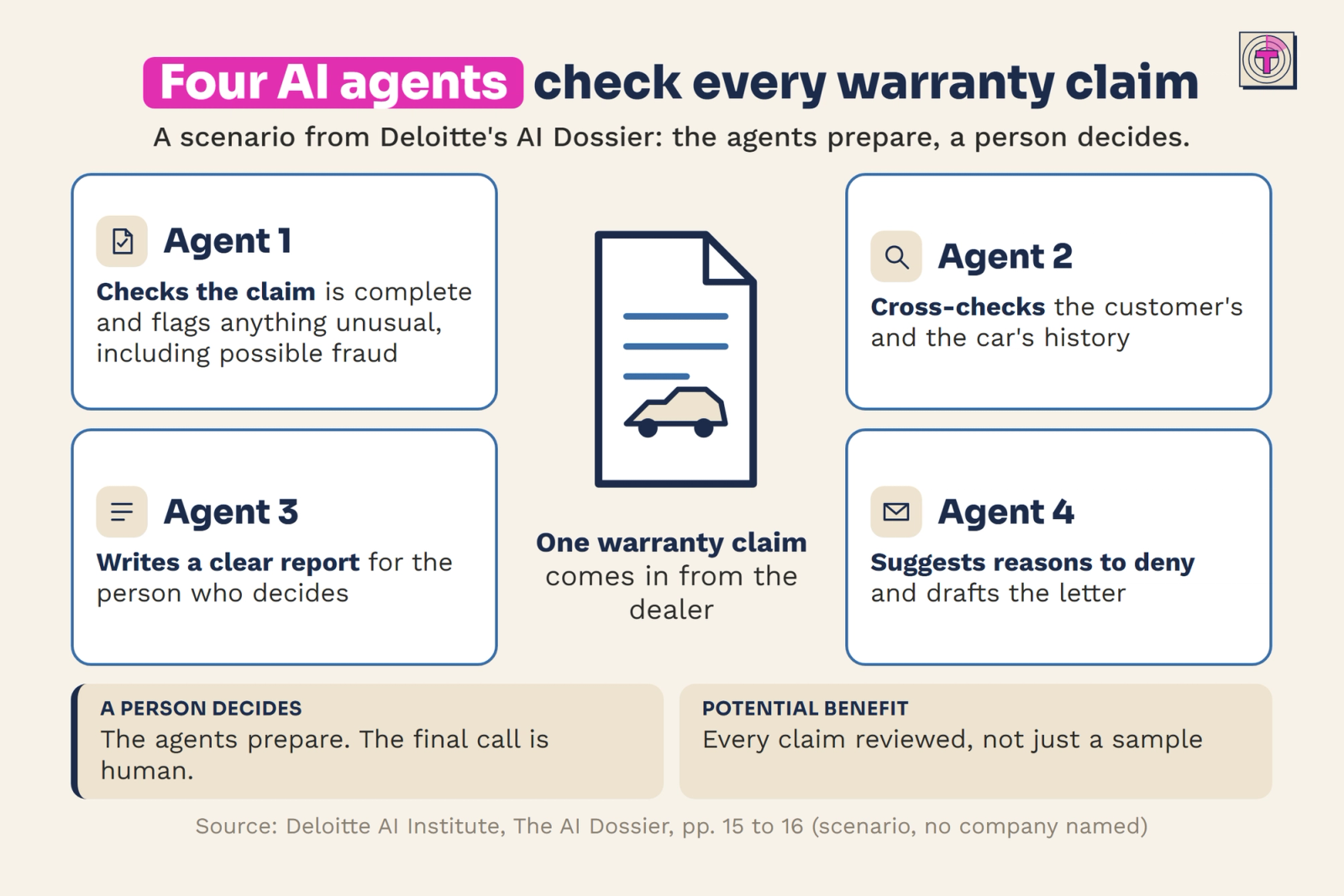
Your car is still under warranty, and a part breaks. You take it to the dealer, who fixes it and sends the bill to the carmaker. That bill is the warranty claim. At the carmaker, someone has to check it. Picture a carmaker where four AI agents do that checking and a person makes the final decision.
This is a scenario from Deloitte's AI Dossier, not a story about one named company. It shows what multi-agent AI can look like in everyday administrative work, and what a smaller version could look like in your own team.
The situation before: checking claims by hand
For a carmaker, warranty claims are a serious matter. Deloitte's AI Dossier says warranty adjudication directly affects costs, customer satisfaction, dealer relationships and compliance.
The way of working it describes will sound familiar to anyone who has handled approvals. The process often involves multiple handoffs, manual reviews and inconsistent action. That slows things down, raises the risk of fraud going unnoticed, strains relationships with customers and dealers, and pushes up administrative costs.
The core problem is coverage. Limited time and resources mean only a subset of claims can be deeply reviewed. Errors, fraudulent claims and incomplete filings can fall through the cracks. In plain words: with so many claims coming in, only some get a proper look.
What the AI does, step by step
In the scenario, four specialised agents handle the work. An agent here is an AI that takes one defined job and carries it out, rather than waiting for someone to ask a question each time. Here is the flow:
- The claim comes in. The dealer's warranty claim for the repair arrives at the carmaker.
- One agent checks the claim. It reviews the claim for completeness, identifies unusual patterns and flags potential fraud, waste or abuse before the claim moves on. In practice, this is the first filter that catches missing information and anything that looks off.
- One agent cross-checks the history. It compares the claim with the customer's and the car's history, looking for relevant information that strengthens the decision.
- One agent writes the report. It produces a clear report for the person who will decide, so they do not have to assemble the context themselves.
- One agent supports the decision. It proposes reasons to deny a claim, with clear justifications, and drafts the denial letter for human approval.
- A person decides. The adjudicator at the carmaker reads the report and makes the final decision.
The pattern is simple. Every agent has one job, the agents prepare the case, and the person decides.
Assistant or agent? Where this sits on the ladder
This case sits at the top of the autonomy ladder used in this series: multi-agent. Several agents split a larger process and hand work to each other, while people set the goal and review the outcome.
It is more than an assistant that answers questions. It is also deliberately short of a fully autonomous system. The AI Dossier says final decisions should be left to human adjudicators, with the agents providing decision support rather than operating as fully autonomous systems. The human check sits at the one point where the stakes are highest: the decision itself.
The results: what the source does and does not say
The source is a scenario, so it names no carmaker and reports no measured results. It lists potential benefits, and it is fair to treat them as possibilities rather than outcomes:
- Increased efficiency and coverage. Automated adjudication allows broader and deeper claim analysis with less time and effort, improving both efficiency and accuracy.
- Improved consistency and fairness. Standardised, AI-supported processes reduce variability in claim outcomes, helping to make decisions more consistent, transparent and fair.
For a reader, the most useful idea is coverage: every claim reviewed, not only a sample.
What it takes
The source does not describe a deployment, so it says nothing about timelines, cost or team size. What it does say is what has to be in place for the agents to be trusted. Their actions should be validated against historical claim datasets and monitored continuously for accuracy. That implies a team needs past decisions to test against, and someone responsible for watching the results over time.
Watch-outs
The AI Dossier names three risks, each with its safeguard:
- Reliability. Errors in root cause analysis or improper routing can lead to incorrect claim outcomes. Validate the agents against past claims and keep monitoring them.
- Explainability. Warranty decisions have a big impact on customers, dealers and regulatory compliance. The agents should give clear reasoning for why a claim was flagged, routed or recommended for denial.
- Accountability. Because of the financial and reputational risks, final decisions stay with human adjudicators.
How to apply this in your own organisation
You do not need a carmaker's volume to use the idea. The scenario is a pattern: several small checks, each done by one agent, preparing a decision for a person.
- Spot the equivalent task. Look for a check in your process that only gets done for a sample, because there is no time to do all of them. Claims, invoices, expense reports and supplier onboarding are common examples.
- Start with the smallest safe version. Pick one check, let AI do it and flag what it finds, and keep a person approving every outcome.
- Write the process down first. List what a complete case looks like and what counts as unusual. An agent can only apply rules you have spelled out.
- Have an owner and past examples. Someone should own the results, and you need past cases to test against before you trust the output.
- Measure two things. Track the share of cases that get a full review and how consistent the decisions are.
- Add steps one at a time. Once one agent works, add a second for history checks, then one for the report, before moving up the ladder.
Key takeaway
The idea is not to hand decisions to AI. It is to let AI do the checking that never gets done at scale, so a person can decide with the full picture in front of them. Start with one check, keep a person in charge of the decision, and add steps as you learn what works.