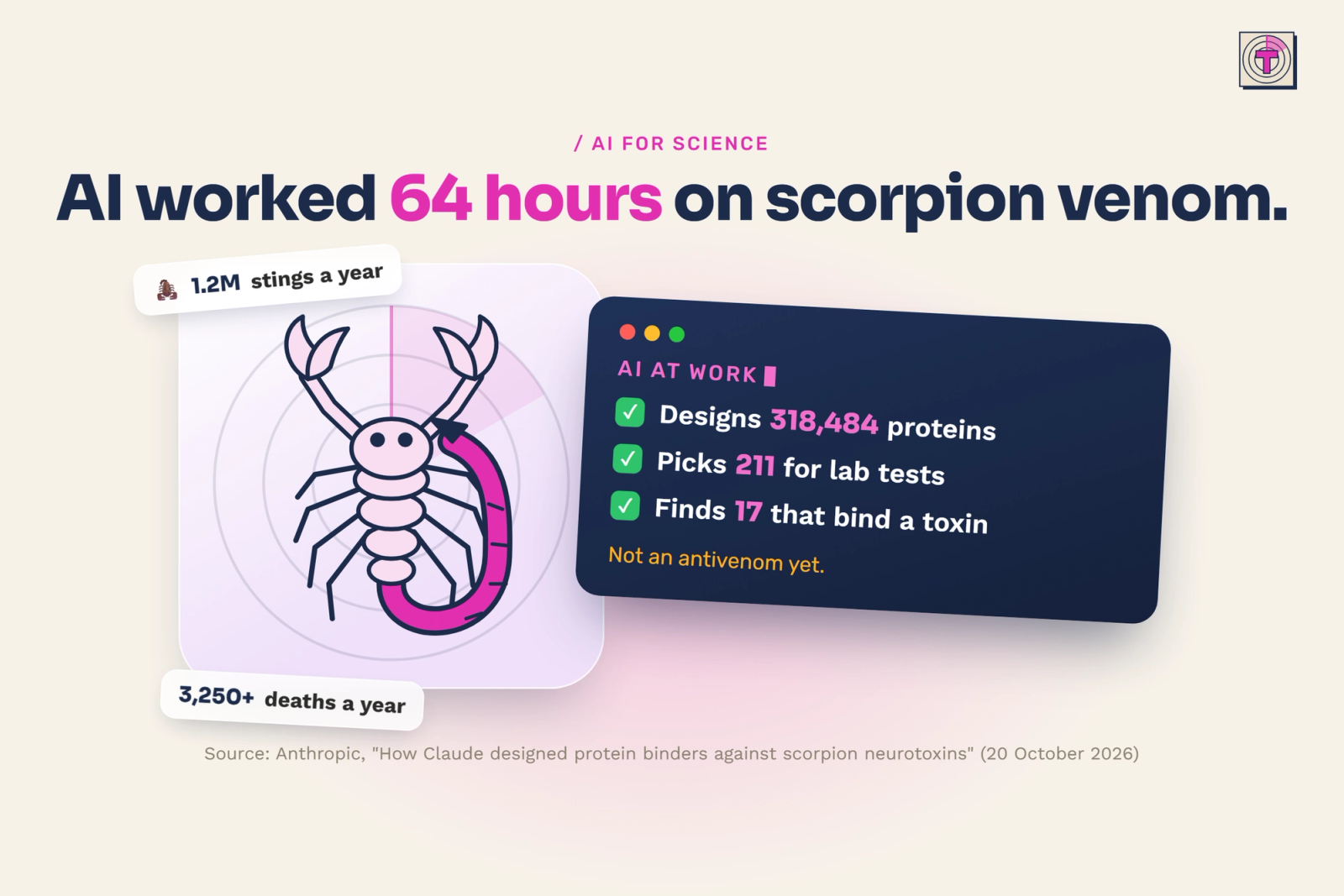
What do AI and antivenoms have in common? This week, the answer is scorpions. Anthropic pointed its AI model Claude at the problem of scorpion venom, and Claude spent 64 hours working on it, mostly on its own. The result is a useful example of what AI is good at in science, and an equally useful reminder of what it has not yet shown.
The problem: a neglected disease with slow solutions
Every year, scorpions sting over 1.2 million people. More than 3,250 of them die, and most of those who die are children.
Antivenom is the standard answer, but it has limits. It takes months to make. It costs a lot. And it only works against a few toxins. That combination is part of why scorpion stings are a neglected disease: the problem is clear, the need is real, and progress is slow.
What Claude did in 64 hours
In this research, Anthropic let Claude run a research campaign for 64 hours, mostly on its own. The goal was to design proteins against scorpion venom.
The numbers show how the work was structured:
- 318,484 protein designs were generated.
- 211 designs went to labs for testing.
- 17 designs met the bar as binders.
Notice the shape of that list. It is a funnel. A very large number of options goes in at the top, and a small number of promising results comes out at the bottom.
Why the funnel matters
It is tempting to read these numbers as a success rate, as if the AI was right 17 times out of more than 300,000. That reading misses the point.
The value is in the narrowing. Going through 318,484 options by hand is not realistic for a research team. Reducing them to 211 worth a lab test is. That is what AI does well in a task like this: not being right every time, but cutting the search down so people can spend their limited lab time on the options most likely to matter.
For professionals outside biology, the pattern carries over. Whenever you face a huge number of possible options and a limited ability to test them, AI can act as a filter that shortens the list before humans and real-world tests take over.
What this does not show
The honest part matters as much as the headline numbers.
This is not an antivenom. Nobody has tested whether these proteins neutralise venom. Binding is a first step, not proof that a treatment works. Until the proteins are tested for their effect on venom, no one can claim they would help a person who has been stung.
It did not work every time. The designs meant to hit several toxins at once all failed. That is a useful limit to remember. An impressive campaign overall still left an important goal unmet.
Reporting both sides is what keeps a result like this credible. The achievement is real, and so are the open questions.
What this means for professionals
You do not need to work in a lab to learn from this case.
- AI is strongest as a filter. The 318,484 to 211 narrowing is the real contribution. Look for places in your own work where the list of options is too long for people to review.
- Autonomy still needs a check at the end. Claude worked mostly on its own, but the results only became meaningful once labs tested them. The same applies to AI work in a business: autonomous output is a starting point, and a person or a real test decides what counts.
- Honest limits build trust. The failed multi-toxin designs and the missing venom test are part of the story, not a footnote. When you present AI results in your organisation, state what was not shown as clearly as what was.
- Pick problems that deserve the effort. A neglected disease with a clear need is a better use of 64 hours of AI work than many of the things AI is currently used for.
How to apply this in your own field
- Find the big list. Look for tasks where you have a very large number of possible options, such as candidates, suppliers, designs, texts or routes, and no capacity to check them all.
- Define what counts as a good result. The funnel only works with a clear test at the end. In this case, labs tested the designs that were picked.
- Let AI narrow, and people verify. Use AI to cut the list down, and keep the final check with humans or with a real-world test.
- Write down what you did not test. Note the open questions next to the results, so nobody mistakes a promising first step for a finished solution.
- Start with a problem that matters. If you are choosing where to point AI first, pick one where a better answer would make a difference to real people.
Key takeaway
Claude's 64 hours on scorpion venom show AI at its best: sifting through hundreds of thousands of options so that people can test the few worth testing. It also shows the limits: this is not an antivenom, and the harder goal of one design for several toxins did not work. For anyone deciding where to use AI, the lesson is to aim it at a clear problem, expect it to narrow rather than to be right every time, and keep people responsible for what happens next.