Most AI tools wait. You open a chat, type a question and get an answer. A new kind of AI agent works the other way around: it reaches out to you before you ask. Anthropic has launched one called Claude Duet, and it shows where AI assistants are heading. This article explains what a proactive agent is, what Duet does, and what to check before you hand an agent a part of your day.
What is a proactive AI agent?
A proactive agent does not wait for a prompt. It watches the apps you connect to it, decides what matters, and contacts you when something needs your attention. The difference from a normal chatbot is who makes the first move.
With a chatbot, you start. With a proactive agent, it starts. That sounds small, but it changes how the tool fits into your day. You no longer have to remember to ask. You also give up some control, because the agent decides what is worth telling you.
What Claude Duet does
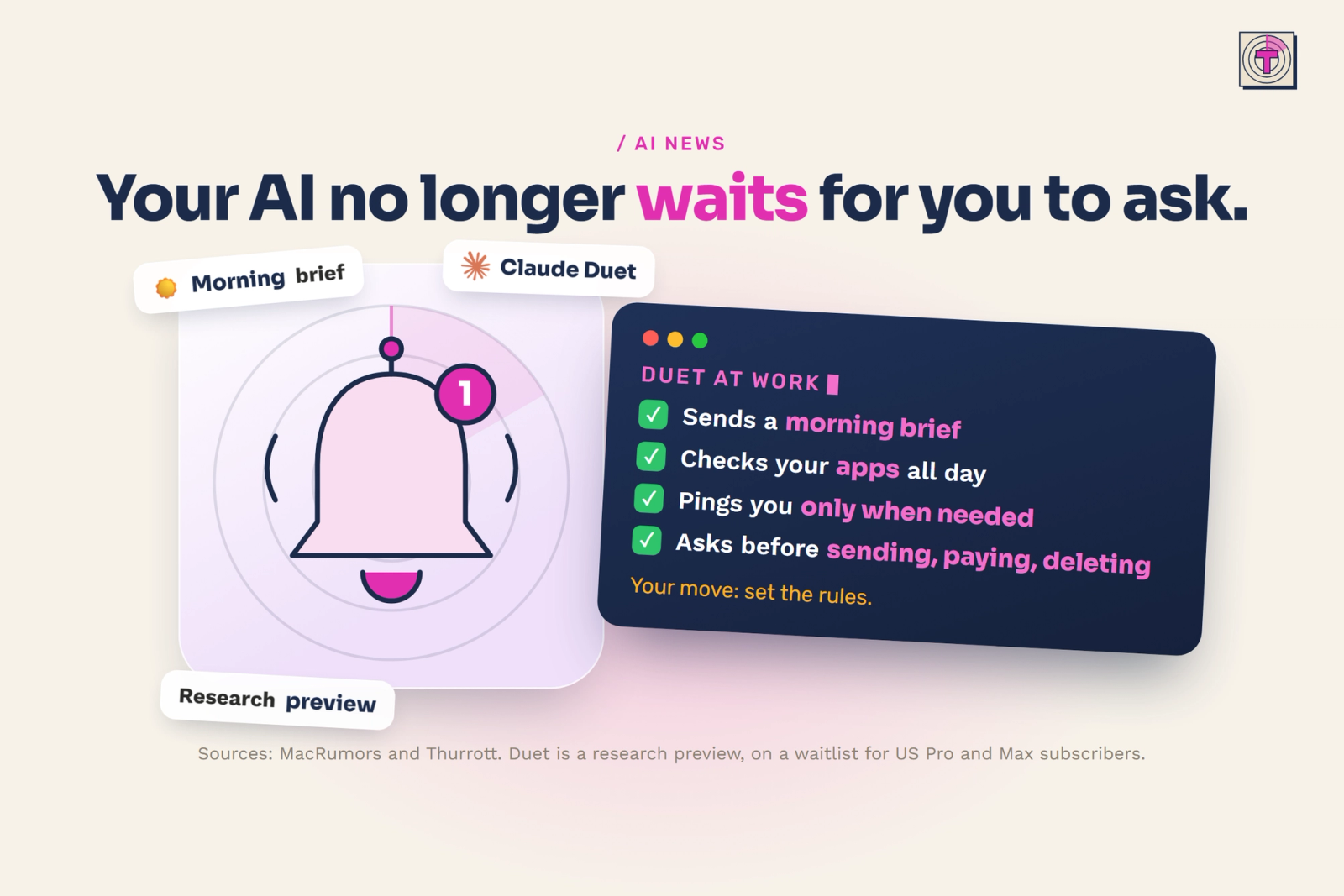
Anthropic's Claude Duet is a proactive agent. Here is how it works, as described at launch:
- A morning brief. Every morning it sends a brief on what matters across your connected apps.
- Check-ins during the day. It checks in through the day and only messages you when something needs you.
- Approval before big actions. It asks for your approval before sending, paying or deleting.
Duet is a research preview, which means it is early and still being tested. For now it is open to Claude Pro and Max users in the US, and people join through a waitlist.
It is not only Anthropic
Meta's Muse and OpenAI's Dots are built on the same idea: an agent that reaches out before you ask. That points to a shift in what the big AI companies compete on.
For the past few years the question was which AI gives the best answer. With proactive agents the question becomes which agent helps you first. An agent that notices a problem and tells you before you ask is useful in a different way than one that gives a great answer to a question you had to think of.
What to check before you hand an agent your inbox
A proactive agent can save you time, but it also acts on your behalf. These four checks help you decide whether to trust one.
1. What it may do alone, and what needs your approval
The most important question is where the agent stops and you take over. Duet asks for your approval before sending, paying or deleting, which are the actions that are hard to undo. When you look at any agent, find out which actions it can take by itself. A good agent keeps the risky ones behind your approval.
2. Whether you can set limits, and whether it sticks to them
Approval for big actions is a start. It is also worth asking whether you can set your own limits on what the agent does, such as which apps it may read or which kinds of tasks it may touch. Then check whether it sticks to them. An agent you cannot limit is harder to trust than one you can.
3. Where it lives
An agent can live in its own app, or inside someone else's platform. This matters because an agent that depends on another company's platform can be limited by that company's rules. Knowing where your agent lives tells you who else has a say in how it works.
4. Whether it takes work off your day or adds noise
The point of a proactive agent is to reduce your workload. If it pings you all day with things that are not important, it adds work instead. After a week of using one, ask yourself a simple question: am I doing less, or am I answering more notifications?
Set the rules first
A proactive agent is only useful if you set the rules first. That means deciding in advance what you want it to watch, what it may do without asking, and what it must always ask you about. The agent works for you, and you decide the boundaries.
If you are curious, start small. Give it one narrow job, such as a daily summary, and watch how it behaves before you let it do more.
Key takeaway
Claude Duet is an early sign of a bigger change: AI that reaches out first. Meta and OpenAI are building the same kind of agent, so more will follow. Before you use one, check what it may do alone, whether you can set limits, where it lives, and whether it takes work off your day. Then set the rules, and let it earn more trust over time.