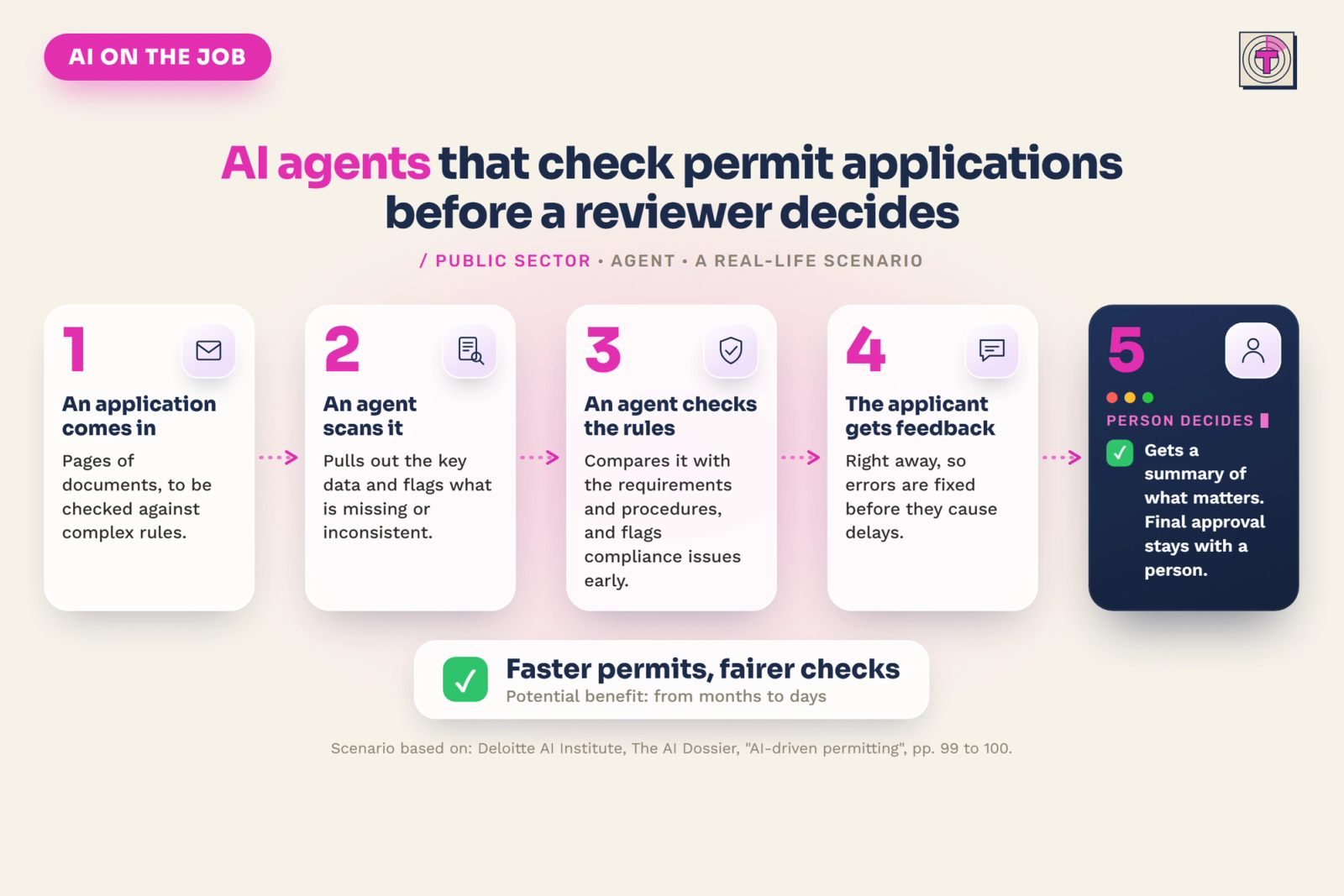
Someone applies for a permit, and the agency has to check a stack of documents against complex rules before it can say yes or no. This article looks at a scenario where AI agents do the first check: they scan the application, test it against the rules and give the applicant feedback straight away. A human reviewer still makes the final decision.
The case comes from Deloitte's AI Dossier, a collection of AI use cases. It is a scenario, not the story of one named agency, so it shows what is possible rather than what one agency measured.
The situation before: slow, hard to follow, and a lot of paperwork
Permitting is a core task for government agencies at federal, state and local level. It covers areas such as land use, energy, waterways and housing.
According to the source, these processes can be slow, opaque and labour-intensive. Reviewers have to assess large volumes of documentation by hand, against regulations that are complex and sometimes overlap. The aim is to meet local, state and federal requirements, so one application can face rules from several levels of government.
Small errors or missing information in an application can cause long delays, which raises costs for applicants and for the agency. At the same time, agencies face larger workloads and limited staffing. Both sides, applicants and regulators, are looking for ways to be more efficient.
In everyday terms: a reviewer spends time on pages that turn out to be incomplete, and an applicant waits to hear what was wrong.
What the AI does, step by step
In the scenario, specialised AI agents take over the first check. Here is the flow:
- An application comes in. Nothing changes about how applicants submit it.
- An agent scans it and pulls out the key data. It checks for completeness and flags information that is missing or inconsistent. In practice: the dull part of reading every page is done first.
- An agent checks it against the rules. Specialised agents compare the application with the permitting requirements, standard operating procedures and applicable regulations, and flag potential compliance issues early.
- The applicant gets feedback right away. Agents give real-time feedback, so applicants can correct errors or add missing documents before delays build up.
- The reviewer gets a summary and decides. Agents summarise the key findings, check that evaluations match the regulatory standards, and point out where a person needs to look. The final approval stays with the human reviewer.
Assistant or agent? Where this sits on the ladder
This scenario sits at the agent level. The agents carry out the checking across several steps: scanning, extracting data, testing against the rules and giving feedback. They work within set requirements, and the reviewer handles the decision.
That is different from a copilot, which waits for a person to ask and suggests each next step. Here the first check happens without someone driving every move. It is also not a system that decides on its own. The source says the agentic system should be used primarily for decision support, with final approval authority kept by human reviewers. That decision is too important to hand over, because permits can carry legal and financial consequences.
The results: what the source does and does not say
The source is a scenario, so it reports no measured results. It lists these potential benefits:
- Lower costs and shorter permitting times. By automating document review and compliance checks, processing times could drop from months to days. That is a possibility, not a result.
- More consistent and fairer evaluations. Applications are assessed against the same criteria, which can reduce differences between reviewers.
- Less frustration for applicants. Real-time feedback makes the process more transparent and helps applicants fix problems earlier, which can improve trust.
What it took
The source describes a scenario and not a deployment, so it gives no timelines, costs or team sizes. What it does say is what has to be in place for the agents to be trusted:
- Verified procedures. The agents should be trained on verified standard operating procedures and kept up to date as requirements change.
- Data protection. Applications often hold sensitive personal and corporate data. The system needs strong protection and full compliance with privacy rules at all three levels of government.
- Human approval. Reviewers keep the final say.
Watch-outs
The source names four areas to design for:
- Consistency. To keep public trust, the agents should apply the requirements the same way to every applicant.
- Reliability. Mistakes in interpreting regulations can lead to wrong approvals or major delays. That is why the procedures the agents work from must be verified and kept current.
- Privacy. Sensitive information needs strong safeguards.
- Accountability. Permitting decisions can have legal and financial consequences, so a person is responsible for the decision, and the agents support it.
How to apply this in your own organisation
You do not need to run a government agency to use the idea. The pattern is: a checking step that happens before a person looks, the same criteria every time, quick feedback to the person who submitted, and a human who decides.
- Spot the equivalent task. Look for work where people check submissions against a list or set of rules, such as applications, forms, tenders, expense claims or supplier documents.
- Start with the smallest safe version. Let an AI check a few incoming submissions for completeness against your checklist, and have a person review everything it flags.
- Get the basics in place first. Write the rules down in one place, keep them current, and decide who owns them. Decide who is allowed to see the documents.
- Give feedback early. Once the checks are reliable, let the people who submit get a quick answer on what is missing, before a reviewer is involved.
- Measure two things. Track how long it takes to give a first answer, and how many submissions come back incomplete.
- Move up one step when it works. Add more checks, with a person still deciding.
Key takeaway
The idea is not to let AI approve permits. It is to let AI do the first check and the first feedback, so reviewers spend their time on the decisions that need a person. Start with one kind of submission, one written checklist and a person who decides, then expand once it works.