Most businesses use one kind of AI for everything: a chatbot that writes. That works well for replies, summaries and plans. It is a poor fit for a different kind of work, the thousands of small decisions that happen behind the scenes every day. This article explains how Jev, an AI decision model from TypeSafe AI, differs from a normal AI model, and how to start using the idea in your own business.
A normal AI model writes, Jev decides
A normal AI model, the kind behind a chatbot, produces something new. You give it a request and it writes a reply, a summary or a draft plan.
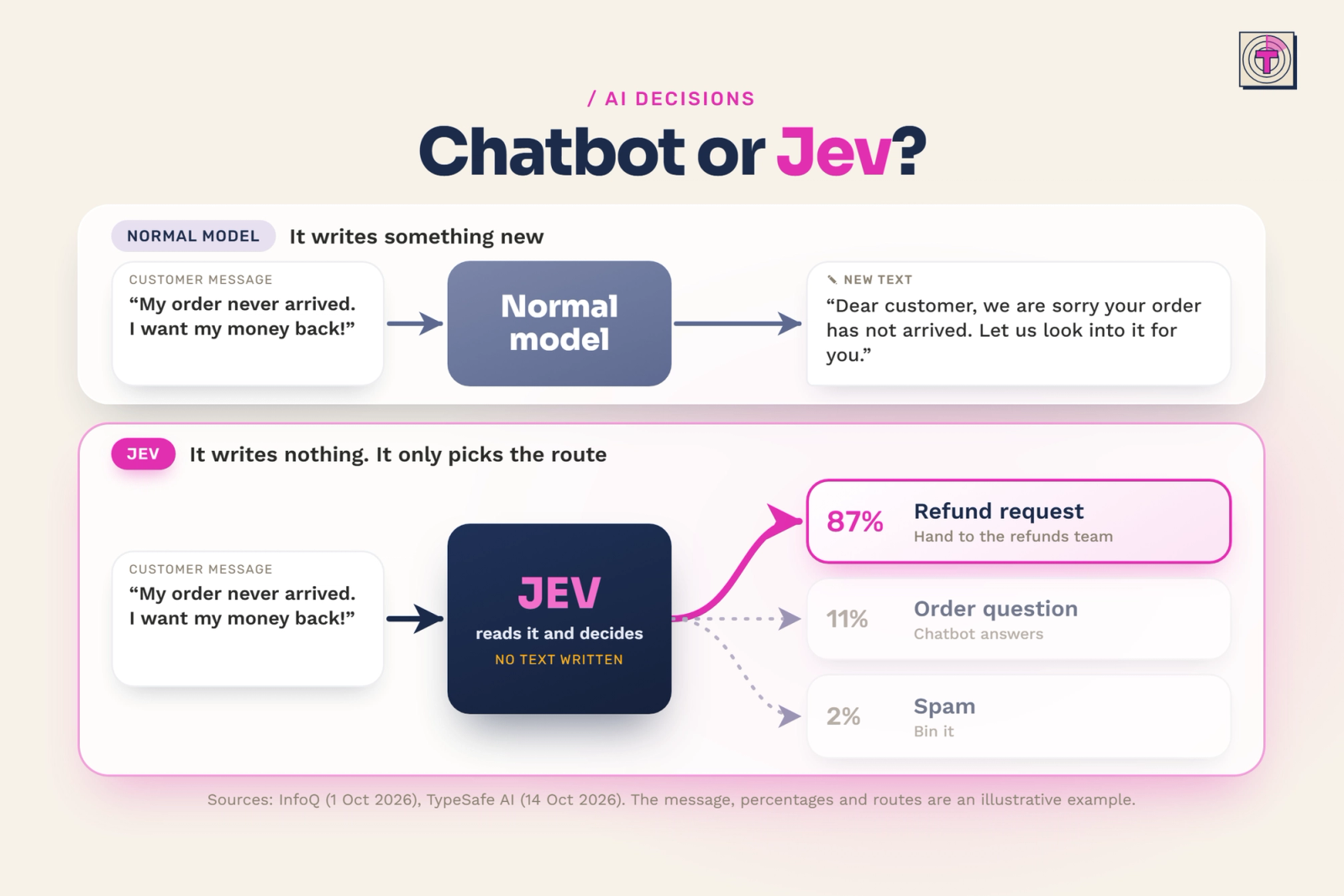
Jev does something else. It writes nothing. You give it a situation and a few options, and it returns a probability for each option, plus how sure it is about its answer. The output is a decision, not a text.
That makes Jev an AI routing model: it reads what comes in and points it to the right place. Your own system then follows that route.
An example: a customer asks for their money back
Take a customer message: "My order never arrived. I want my money back!"
A normal model reads it and writes a reply, for example an apology and a promise to look into it.
Jev reads the same message and writes no reply at all. It returns something like this (an illustrative example, not real output):
- Refund request: 87%. Hand it to the refunds team.
- Order question: 11%. Let the chatbot answer.
- Spam: 2%. Bin it.
The most likely route, the refund request, goes to a person who can act on it. Jev picked the route. The system, and the people behind it, do the rest.
Why the difference matters
Many business processes are not about writing. They are about deciding where something goes, how urgent it is, or whether it may continue. These decisions repeat all day, and they need to be quick and cheap. Jev is built for that kind of work: it is cheap and fast enough for decisions that happen thousands of times a day.
The probability and the confidence are the useful part. They let you set rules such as "act automatically when the answer is clear, and ask a person when it is not." A plain text reply cannot give you that kind of control.
Where to use Jev, and where not to
A simple way to choose is to ask whether the task needs new text or a decision.
Use a normal model for:
- replying to a customer
- summarising a contract
- drafting a plan
Use Jev for:
- sorting the inbox into urgent, normal and spam
- deciding which AI model should answer a question
- checking an AI agent's action before it runs
Use neither for:
- doing sums
- comparing dates
For calculations and date comparisons, keep the work in code. Ordinary code does this reliably, and it is not what a decision model is for.
How to apply it in your business
You do not need a large project to try this. These four steps are suggested starting points:
- List your repeat decisions. Look at the work your team sorts, routes or approves again and again, such as tickets, invoices, leads and approvals.
- Set a threshold. For example, above 90% sure, the decision runs automatically. Below that, it goes to a person. The 90% is a starting point, so adjust it to the cost of a mistake.
- Test it on 50 past cases. Compare Jev's answers with the answers your team gave. This shows how well it fits your own work before you rely on it.
- Keep the writing for a normal model. Once a message has been routed, a normal model can still write the reply.
Measure before you switch
Accuracy matters as much as speed and cost. One CTO found that Gemini was slightly more accurate at sorting email, but 10 to 20 times more expensive. A small difference in accuracy can be worth a very large difference in cost, or it can matter a lot, depending on the task. That is why the test on past cases is worth doing before you switch anything.
Key takeaway
A chatbot and Jev do different jobs. A chatbot writes. Jev decides where things go, and tells you how sure it is. For work that repeats thousands of times a day, a routing decision with a clear confidence level is often more useful than another piece of text. Start by listing your repeat decisions, set a threshold, test on real past cases, and keep people in the loop for anything the model is unsure about.